Employee safety, booking channel control, and compliance: the three pillars of a resilient travel policy in uncertain times. In an environment where risks are constantly evolving, companies are rediscovering a simple yet often underestimated truth: you can only effectively protect what you can see.
What happens when employees book travel through consumer platforms or last-minute tools, outside controlled channels? In stable times, these are minor inefficiencies. In a volatile geopolitical context, they become blind spots. And in business travel, blind spots quickly turn into real risks.
As organizations strengthen their security frameworks, one key principle stands out: visibility is the backbone of modern Duty of Care. Without a consolidated view of travel activity, companies cannot locate employees, activate emergency protocols, or anticipate disruptions.
Leakage, in other words, bookings made outside managed channels, thus becomes the Achilles’ heel of travel management.
“Leakage doesn’t just undermine travel policy. It creates blind spots that prevent companies from effectively protecting their employees. Safety starts with visibility and traceability of travel.”
– Agnieszka Piekarska, Head of Account Management, Goelett
Centralize, track, protect
To address these challenges, Self Booking Tools (SBTs) play a critical role by centralizing travel flows and enhancing visibility across all journeys.
End-to-end visibility across all travel
Flights, trains, hotels, and ancillary services are consolidated into a single environment. This centralized approach provides a reliable foundation for managing travel security.
Compliance embedded in the user experience
Through smart filters, alerts, and recommendations, employees are naturally guided toward policy-compliant choices, without adding friction to the booking process.
Reduced leakage through better experience
By offering a seamless, intuitive experience and clear information, SBTs reduce out-of-channel bookings and ensure that all travel data remains centralized and actionable.
Real-time data for faster, smarter response
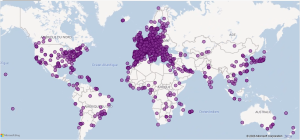 Real-time tracking and reporting tools add an operational layer, enabling companies to act quickly and effectively.
Traveler tracking and location
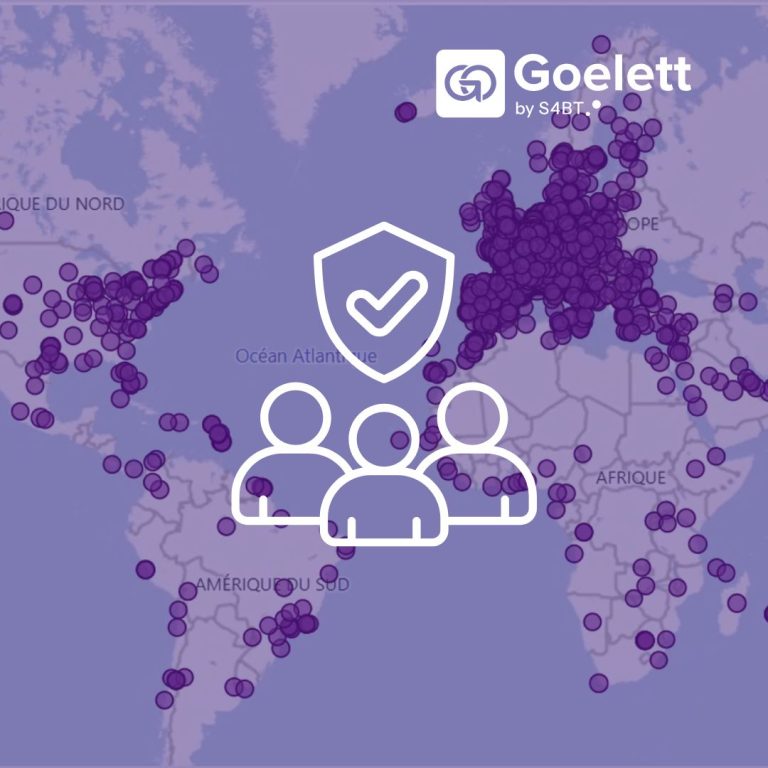
Visualization interfaces make it easy to identify where employees are and what journeys are underway. In the event of an incident, this enables quick identification of impacted individuals, rapid communication, activation of appropriate response procedures.
Consolidated information
Transport, accommodation, changes, and cancellations – all data is centralized, providing an operational overview essential for managing risk situations effectively.
Advanced controls to protect employees
Some platforms, such as Goelett, allow companies to restrict or frame bookings to sensitive areas. These features help ensure that travel takes place within a more secure framework, aligned with internal policies.
In this context, SBTs become practical tools supporting Duty of Care and, more broadly, corporate social responsibility commitments. Case law, such as the Karachi ruling, highlights that an employer’s duty of safety cannot remain theoretical—it requires effective means of prevention, monitoring, and intervention.
Reinventing Duty of Care
The world is changing, sometimes abruptly. Companies must adapt, anticipate, and react quickly. In this environment, Duty of Care can no longer be confined to a section of an internal policy. It has become a daily operational priority, at the core of corporate mobility strategies.
By combining real-time visibility, leakage reduction, and a modern user experience, business travel tools enable a critical shift: from theoretical safety to practical, actionable, and measurable protection.
Because now more than ever, safety starts with visibility.
Learn more: 📩 communication@goelett.com